- Service
- Digital Diagnostic Evaluation
- Business
- Home-improvement company, two locations
- What I used
- Public information only, no account access
- Report
- 6 pages, plain English
Where things stood
The business had decades of good work behind it, but almost all of its online customers were coming from paid ads.
- More than 9 in 10 search visits came from paid ads (third-party estimate).
- The owners couldn’t tell what was working and what wasn’t.
- They needed answers they could act on, not a stack of marketing jargon.
The plan and the work
Searched like a customer
I searched from each city the business serves, the way local homeowners do. I tested the website on a phone and compared the business to five competitors that show up right next to it.
Checked every finding by hand
Tools helped me look. They didn’t decide anything. I checked each finding myself before it went in the report.
Ranked the fixes
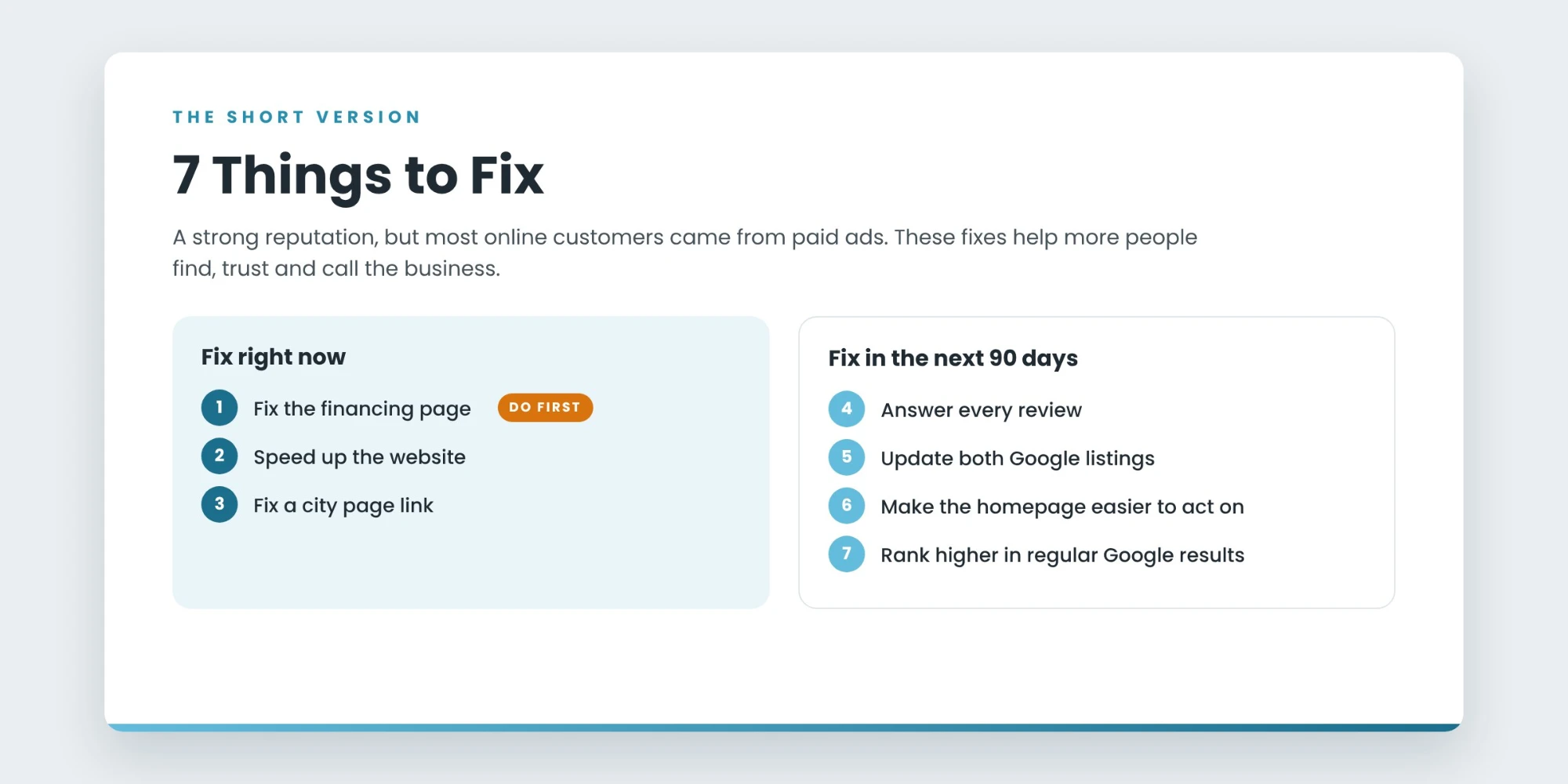
I split the seven fixes into two groups: three to fix right now (each takes days) and four to fix over the next 90 days. Each fix came with what’s wrong, why it matters and what to do.
What I found
| What I found | Why it mattered |
|---|---|
| A financing page still showed unfinished placeholder text | Customers ready to spend thousands saw a page that looked unfinished |
| The mobile experience caused visitors to wait before pages started to load | Google scored it 31 out of 100 on phones, and slow pages lose paid visitors |
| A city page link pointed to the wrong page | Google ranked the homepage there instead, far behind competitors |
| Google Reviews were mostly going unanswered | A competitor with fewer reviews was answering nearly all of them and ranked first on the map |
| The two Google listings didn’t match | Different names, a missing service and an old description |
| The homepage made visitors work to find the next step | Small gains in calls and form fills add up to more leads |
| The business wasn’t on page one for its main searches | Without free visits, nearly every customer had to be paid for |
The owners got a short report they could read in a few minutes and act on right away. Each fix was tied to what it was costing them, in plain English. The biggest takeaway: a trusted name was being held back online by problems that are fixable.